Thursday, October 29, 2009

Young talent is eager to bring sustainability into the industry


Many of us in the landscape industry are grappling with the concept of sustainability, something that I've been researching and attempting to understand for more than a year.

The more I learn about sustainability as it relates to the landscape/lawn service trade the more I'm convinced that we have to embrace it from an environmentally responsible AND a business standpoint.

That was one of the dominant themes at PLANET's Green Industry Conference (GIC) in Louisville this past week. Lots of presenters at GIC have been sharing information on the topic. Their messages all start with the same introduction, at least when it comes to the "green" portion of sustainability -- it's not a passing fad.

Tim Schauwecker, program coordinator at Mississippi State's excellent Landscape Management program, reinforced just that point. Tim was the moderator at one of the 80 or so round tables at the Thursday morning Breakfast of Champions event at PLANET's GIC. Me and four other contractors spent more than an hour learning about what's coming down the road in terms of sustainability, spending much of our time getting up to speed with LEED and the Sustainable Sites Initiative that the American Society of Landscape Architects, the Lady Bird Johnson Wildflower Center and the U.S. Botanic Garden are preparing for its eventual incorporation into LEED.

LEED is program run by the U.S. Green Building Council to make buildings more energy efficient, healthy for occupants and friendly to the environment. It is having a huge impact on the construction trades.

SSI may have an equally large impact on the landscape/lawn service industry, once SSI gets paired with LEED. Keep your eyes on its progress.

But, back to Tim and what's going on with his program. He says that the 70 or so students he has contact with at MSU in Starkville, MS, are on top of this sustainability issue like gnats on a ripe peach. Learning the "green" way of providing products and services is becoming a bigger piece of their educational experience, he says.

This leads me to wonder that as they (and students from other progressive horticulture and landscape programs), start their careers within our companies and/or create their own companies, how much farther they will drive this issue of sustainability, within our industry, especially its environmental components.

There is a lot of bright, ambitious young students in these programs. What impact is this educated but inexperienced talent having on your companies?

-- Ron Hall

Friday, October 23, 2009

Addressing the 'hydro-illogic' cycle

Dr. James Beard, professor emeritus Texas A&M University and a world-famous turfgrass expert, wryly refers to “the hydro-illogic cycle” when discussing the water needs of lawns, sports fields, golf course and other properties.

“When there’s a drought, authorities go into a panic and start saying ‘we have to do something.' When it starts to rain again the panic passes and they say ‘oh well, we really don’t have to do anything.’ That’s the hydro-illogic cycle,” says Beard.

The hydro-illogic cycle, of course, is quite different from the hydrologic circle (or cycle).

Well-known to anyone who studies water, the hydrologic cycle refers to the process where fresh water is continually recycled, being dumped onto the earth as rain or snow and returning to the atmosphere as water vapor from the oceans and the earth’s land masses. The process is repeated over and over again, year after year, decade after decade, century after century, eon after eon.

In other words, when we use the term water scarcity we’re usually referring to a regional lack of fresh water, not water in total, which covers three quarters of the earth’s surface. The amount of fresh water by comparison is tiny, just 2.5% of the total. More startling yet is the amount of fresh water available to sustain our societies, less than 1% of world’s supply of fresh water. Most fresh water is locked up in ice at the poles, in glaciers, in soil moisture and in very deep aquifers.

But even this tiny amount of available fresh water would be sufficient to sustain our needs if it was captured and distributed and used efficiently. This of course starts with using what we already have more efficiently, the least expensive source of “new” fresh water.

Beyond that, lack of reservoirs, the need for additional distribution (including infrastructure badly in need of replacement) and too little reuse of the water we already have are at the core of our regional water shortages

Says Beard, there is no reason for water to be scare, particularly in the eastern United States that gets enough precipitation (even if it is unpredictable) to sustain forests of trees, which research has shown require far more water than turfgrass, he adds.

Will the water hydro-illogic cycle be repeated in north Georgia and into the Carolinas, a region that suffered one of its worst droughts on record in 2007-2008. That drought caused billions of dollars in lost revenues in agriculture, the Green Industry and other water-dependent businesses.

The region is predicted to remain one of the fastest growing in the nation for the next 30 years and the region will almost certainly be revisited by droughts.

Now that the rain has returned to this region and its flush with water, will policymakers there put new sources of fresh water on the legislative backburner?

Thursday, October 22, 2009

These H2B 'facts' are way out of line

Can this be true — that 98% of legal, seasonal H2B guest workers are paid wages lower than the prevailing wage reported by the Bureau of Labor Statistics?

Or that 64% of the cases the DOL-certified wage fell below 75% of the mean hourly wage?

A Washington D.C. “think tank” known as the Economic Policy Institute reported in 2008 that it is true. The EPI said it gathered these findings from 15 states, which it listed at the end of a short article.

In our opinion, the EPI has to offer a lot more explanation of how it came up with these numbers before they’re taken as credible. Unfortunately, once they’re reported they're taken as fact and are freely shared.

For example, the 98% statistic turned up in an Oct. 21 article in the Los Angeles Times. The statistic jumped out at us because our personal experiences in visiting with landscape companies and documenting their H2B workers have been the opposite — that employers desirous of keeping these valuable workers pay them the prevailing wage in their particular regions. And as these workers gain skills and experience more than the prevailing wage.

With the U.S. economy at near full employment from the late 1990s until just a few years ago, just about every landscape company owner with H2B workers told us the same thing— they couldn’t find able-bodied U.S. workers willing to show up every day to do routine landscape work, such as mowing, trimming and installing hardscapes . . . even at prevailing wages, which are admittedly lower than union scale but in line with other service industries.

Our experiences visiting and meeting with landscape company owners and, indeed, many of their seasonal guest workers puts to the lie the claim — an exaggeration that makes it absurd on the surface— that 98% of legal, seasonal H2B guest workers are paid wages lower than the prevailing wage.

Statistics like this are often picked up and passed on as fact. Coupled with today’s bleak employment picture, which has savaged job prospects for U.S. workers and guest workers alike, it's unlikely that the present administration or Congress will look at guest worker programs favorably when they get around (if they ever do) to an immigration overhaul. — Ron Hall

Thursday, October 15, 2009

Reicher going to Nebraska; Purdue seeking new turf extension specialist

WEST LAFAYETTE, IN — Purdue University is looking for a Turfgrass Extension Specialist. The position becomes available July 1, 2010. Dr. Zac Reicher, who presently holds that post, announced this past summer that he is leaving Purdue after 21 years there (17 as Extension Specialist) to take a position with Extension at the University of Nebraska-Lincoln.

Reicher said in a recent Purdue enewsletter that he took the position because his wife accepted a position at the University of Nebraska as Director of Landscape Architecture and Regional Planning in the School of Architecture.

“I am what’s considered a ‘spousal hire’ in university speak, which means if the school wants one person bad enough, they’ll make room for their spouse if qualified,” Reicher wrote in the newsletter.

Reicher said the he's excited to be joining the strong turf team in Nebraska but has mixed feelings about leaving central Indiana.

“The turf staff and administration at Purdue, the Midwest Regional Turf Foundation and the entire Turf Industry have been very, very good to me,” wrote Reicher. “On the other hand, Nebraska offers the chance to start over, tackle new opportunities and hopefully build on an already strong program undergoing significant changes with retirements.”

If you’re interested in the Purdue job and you have a Ph.D. degree in Crop Science, Agronomy, Horticulture, Plant Ecology or related disciplines, you might want to contact Dr. Cale Bieglow at cbigelow@purdue.edu or Dr. Herb Ohm at hohm@purdue.edu.

For more information about Purdue Agronomy and the Turf Science Program, visit the Web site here.

Tuesday, October 13, 2009

Sustainable Sites accepting applications for pilot projects Nov. 5

The Sustainable Sites Initiative will accept applications for pilot projects starting Nov. 5 and closing Feb. 15, 2010, in conjunction with the release of the next report and new rating system, called The Sustainable Sites Initiative: Guidelines and Performance Benchmarks 2009.

Any type of designed landscape is eligible to participate, ranging from academic and corporate campuses, parks and recreation areas, transportation corridors to single residences so long as the total size exceeds 2,000 square feet. Fees for participating in the pilot project process may run from $500 to $5,000 depending on project budget (Note, limited scholarships will be available). Approximately 75 to 150 projects will take part in testing the first national rating system for sustainable landscapes.

The Sustainable Sites Initiative is a partnership of the American Society of Landscape Architects (ASLA), the U.S. Botanic Garden and the Lady Bird Johnson Wildflower Center.

Until now, design and construction rating systems included little recognition for benefits of sustainable landscape and site design. Landscapes can clean water, reduce pollution and restore habitats, all while providing significant economic benefits to land owners and municipalities. The U.S. Green Building Council, a stakeholder in the Initiative, anticipates incorporating the Sustainable Sites guidelines and performance benchmarks into future iterations of its LEED Green Building Rating System.

Visit the Sustainable Sites Web site on Nov. 5th for the online pilot project application. For email updates on Sustainable Sites, click here.

Friday, October 09, 2009

Big plans for turning Philly greener

PHILADELPHIA — This city has proposed tackling its combined-sewer overflow problems with a $1.6 billion, 20-year plan that would use rain gardens, green roofs, thousands of additional trees, rain-harvesting barrels and porous pavement, The Philadelphia Inquirer reported September 27.

Environmental experts and federal regulators are reviewing the 3,369-page plan put forth by the Philadelphia Water Department.

The green capture plan is being hailed as one of the most ambitious ideas to reduce combined sewer overflows and increase “green” living of a major metropolitan area. According to the plan, runoff is reduced, diverted or filtered by layers of soil and plant root systems. The Inquirer reported, “Some areas would temporarily store runoff until the stress of the storm on the combined sewer system is reduced and the water can then be treated in the sewer treatment plants.”

Thursday, October 08, 2009

Landscaping to soothe our harried souls...can you dig it?

Landscape professionals increase their competence and marketability by gaining the knowledge and experience to earn industry certifications. National organizations provide certification opportunities as do many state associations.

Here’s a new one on us. It’s called Project NatureConnect (PNC), which is headquartered in beautiful Friday Harbor, in Washington State’s San Juan Islands. It’s not a certification program as much as an educational/learning program.

“Landscapers learn holistic gardening techniques that include teaching their clients how to use nature – connecting activities to create personal healing garden designs and therapeutic backyard landscapes that increase wellness and spirit, says the PNC.

Program Director Dr. Michael J. Cohen has published landscape studies at the PNC Web site that show that pictures of peaceful relaxing landscapes evoke calm and tranquility in most individuals. . . Better yet, the real thing — beautiful landscapes that reconnect people to nature.

“At Project NatureConnect, to become therapists, landscapers learn online, how to use and teach as many as 147 nature-reconnection activities. They use them to help their clients discover special attractions in nature that peacefully fulfill their natural senses: plants, flowers, scents, sounds, etc.,” says a release from the PNC.

The PNC offers online training, job, Masters or Ph.D. degree programs at its Institute of Global Education. According to the release, it “enables our psyche to walk nature's path to socially and environmentally responsible relationships, stress reduction and sustainable livelihoods.”

Hey, I can dig it . . . to resurrect a phrase I haven’t used since my Nehru jacket days. — Ron Hall

Wednesday, October 07, 2009

Tiltometer encourages safer mowing

The Tiltometer sounds like something you might find at a neighborhood carnival, but it’s no amusement park thrill ride. In fact, the Tiltometer’s purpose is to keep mower operators safe. Glendale Grounds Management, based in Leeds, West Yorkshire, England, uses it and other safety innovations to prevent workplace injuries.

Designed by Glendale engineer Angus Lindsay and built by machinist Gavin Blair, this simple device allows mower operators to experience what a particular angled slope would actually feel like, reports the UK trade journal Horticulture Week. So, what exactly is a Tiltometer? It consists of a mower seat on a frame that can be jacked up to varying angles. It’s that simple. Glendale is also working with a manufacturer to produce an “inclinometer” to be installed on its commercial mowers.

Why is this important? Each year more than 80,000 people in the United States are injured in mowing accidents. Some of the most serious, including deaths, occur when mowing on steep hills or embankments, which leads me to remind you of the STARS (Safety Training Achieves Remarkable Success) program offered by the Professional Landcare Network (PLANET). If you're in the landscape business and you're not participating, you should be. — Ron Hall

Tuesday, October 06, 2009

U.S. EPA moving toward disclosing identities of pesticide inert ingredients

WASHINGTON, D.C. — The Environmental Protection Agency is moving forward with a plan to disclose the identities of all inert ingredients in pesticides including those that are potentially hazardous. The EPA says the increased transparency will assist consumers and users of pesticides in making informed decisions and will better protect public health and the environment. Pesticide manufacturers typically disclose their inert ingredients only to EPA. Currently, EPA evaluates the safety of all active and inert ingredients in a product’s formulation when determining whether the pesticide should be registered.

The Agency anticipates publishing its proposed rulemaking in the Federal Register within the next few months. In it, EPA will discuss ideas for greater disclosure of inert ingredient identities, including inerts associated with various hazards, as well as inerts in general. EPA believes one way of discouraging the use of the more hazardous inert ingredients in pesticide formulations is by making their identities public. In addition to pursuing regulatory action for inert disclosure, EPA is considering encouraging voluntary initiatives to achieve this broader disclosure.

On Sept. 30, EPA responded to two petitions (one by Northwest Coalition for Alternatives to Pesticides, and a second by certain State Attorneys General), that identified more than 350 inert pesticide ingredients as hazardous. The petitioners asked EPA to require these inert ingredients be identified on the labels of products that include them in their formulations.

See also the U.S. EPA's Oct. 1 release: EPA Opens Transparency Window into Pesticide Registration Decisions

Sunday, October 04, 2009

Congratulations to David J. Frank for 50 years of service


GERMANTOWN - David J. Frank celebrated 50 years in the landscaping business by inviting everyone to his party at his place this past Friday. Frank used the occasion to hold a blood drive and a collection day for a food pantry and Condella's Coats for Kids.

Click here for a 2-minute video from Fox 6 featuring the party.

Congratulations from Landscape Management magazine David J. Frank for a half-century of service.

Tuesday, September 29, 2009

Canada's anti-pesticide crusade marches on

Calgary, a city of about a million people in southern Alberta Province, has been holding public hearings to determine whether it should ban “the cosmetic use” of common lawn care chemicals there.

The meetings have been drawing dozens of local citizens. The discussions have been heated with anti-pesticide proponents pushing for the ban and people involved in the lawn service industry arguing against it.

Calgary’s city council is expected to make a decision on the ban sometime yet this fall.

We’re not blessed (or cursed) with the ability to see into the future, but if we had to lay down a wager on this one, our tenspot would be on a Calgary ban on the use of these chemical lawn controls.

If you’ve been following this blog you know that cities (and several provinces) in Canada have been on a pesticide banning binge — responding to the wishes of well-organized, well-funded and aggressive activist groups. The anti-pesticide crowd couches its crusade as a public health campaign, disregarding the country's regulatory system that has tested and approved these products for use.

Lawmakers, either for political reasons or fearful of being perceived by their constituents as being unresponsive to their well-being, accept the anti-pesticide safety allegations without critical examination. — Ron Hall

“Pesticide bylaw draws a crowd,” cbc.ca, Sept. 24, 2009

“Alberta bans weed and feed products,” cbc.ca, Nov. 13, 2008

“N.S. municipalities want cosmetic pesticide ban,”
cbc.ca, Sept. 28, 2009

Monday, September 28, 2009

Regarding turfgrass — let's get our facts straight first

The City of Boerne is a progressive little city (about 7,000 people) in the middle of beautiful Hill Country in central Texas. . . Well, actually, its leaders might be a bit too progressive.

This past week, in a 3-2 vote, its city council shot down a proposal to allow St. Augustinegrass to be used in the city. A previous city council in Boerne had banned that particular species of lawn grass in new lawns in 2004 because it claimed St. Augustine required too much water.

Texas has a serious problem in terms of its future water supplies so the concern by the local lawmakers with protecting the water that they already have is certainly laudable.

What’s not so certain, however, is council’s knowledge of turfgrass or its water needs. As anyone who is familiar with turfgrass knows, it’s not turf’s fault that water is wasted on it; it’s the fault of the person irrigating the turfgrass.

Proof of this lies literally on Boerne’s doorstep. Several years ago, with funding by the San Antonio Water System and Texas Turfgrass Producers, turfgrass researchers Dr. David Chalmers and Dr. Kurt Steinke, Texas A&M University, conducted a 2-year turfgrass drought tolerance study at the new Irrigation Technology Center in San Antonio, which isn’t that far from Boerne.

The researchers (Dr. Steinke has since accepted a position at Michigan State University.) got some fascinating and heartening insights into the ability of turfgrass to survive lack of rain and to recover when it returns. The study consisted of subjecting 25 lawn grasses (including St. Augustine) to 60-day drought conditions using a one-of-its-kind rainout shelter.

In a nutshell, what the study discovered was that turfgrass is a lot tougher (at least when it comes to surviving lack of water) than most people realize. They also discovered that it survived much better when it had been established on native soils than when it was established in a 4-in. layer of topsoil.

No disrespect to the City of Boerne, which sounds like a delightful place, or its well-meaning lawmakers, but before they consider legislation targeting turfgrass, including St. Augustine, they might give a look to the final report of the “60-Day Turf Drought Recovery Project,” at the ITC Web site here. —Ron Hall

Friday, September 25, 2009

Is this the best irrigation catch can in the world?


If you do irrigation audits you can toss your tuna cans into the recycle bin. Texas AgriLife Extension Service engineers claim they have the best designed irrigation catch can in the world — The Aggie Catch Can.

"This design change is significant as it greatly reduces splash-out during sprinkler testing, thereby improving the accuracy of tests to measure the efficiency and application rates of irrigation systems," said Dr. Guy Fipps, AgriLife Extension engineer and designer of the new catch can.

In theory, monitoring irrigation applications is simple, Fipps said. One simply puts out containers and runs the irrigation system for a specified amount of time. Everything from tuna cans to cups are used, but the results must be converted to inches of water applied over the area. Rulers or graduated cylinders and calculators are needed for the process, and the chance for error by non-professionals is high.

The Aggie Catch Can, however, is cone-shaped and has graduated markings in both inches and millimeters.

"Unlike tuna cans, catch volumes may be read directly without the need for rulers or graduated cylinders," Fipps said.

Other advantages to the can are that its cone shape allows it to be easily stackable with other units. Also, it comes with a stainless steel stand that is staked in the ground.

"This means it can be used on uneven or sloped sites," Fipps said.

The irrigation catch can is now available through the AgriLife online bookstore. at http://agrilifebookstore.org. A set of 12 cans with stands costs $54 plus shipping. At the bookstore, search for item number SP-368.

With water and energy costs being what they are today, irrigators can quickly pay for the cost of the cans by properly calibrating their systems, Fipps said. Also, reducing over-irrigation is vital to preserving the state's resources.

"As about 40% of municipal water use is for landscape irrigation, conserving water in landscapes is important if Texas is to be able to meet its future water demand," said Fipps, who is also the director of the Texas Irrigation Technology Center.

The Aggie Irrigation Catch Can was developed with support from the Rio Grande Basin Initiative.

Thursday, September 24, 2009

Guidelines to sustainability


The Professional Landcare Network is ready to release a major publication dealing with sustainability as it applies to the landscape industry. "Green Industry ECOnomics: Innovating toward a sustainable and profitable future," is the title of the publication — Crystal Ball #29. It will be released soon. Get it. Read it.

Meanwhile, here's an interesting case study from Dallas highlighting some of the same principles explained in the PLANET pub:

Residential Architects Stephen B. Chambers Inc., an architectural firm that specializes in modern and traditional residential design, remodeling, and historic renovation, recently completed a home here using many of the principles of sustainable design. Particular attention was paid to efficient use of space and the conservation of energy, water and other natural resources on the site.

“The client’s primary goal in the design of this new home was to downsize to a single-level, low-maintenance, high-efficiency home,” says Chambers. “Protecting the environment, and conserving the site’s natural resources also were important elements. As we progressed through the design process, we carefully studied how to create a Modern Texan design that integrates with nature and provides a habitat for migratory birds and butterflies.

The residence was built to provide food and water for wildlife by providing animals with food and water. This in no way impedes the experience of the garden; it is designed to allow man and animal to co-exist without hindering each other. We also created cover for wildlife, where animals can hide from people and predators alike. Places are provided for wildlife to build nests and have their young. Special attention was paid to landscaping to further make the residence a real certified wildlife habitat.

Another unique feature of this home is a 1,650-gal. galvanized steel cistern in the front yard that serves a real purpose in providing supplementary landscape irrigation by collecting rainwater from the roof. Symbolically, it reminds us of how important water is as a resource.

Steve remembers that his mother, who was raised in Nebraska during the Dust Bowl of the 1930’s, used white porcelain bowls in the 1950’s in Dallas to collect rainwater from the roof downspouts to wash her hair. “Somehow, in just a few generations,” Steve says, “we have forgotten what a scarce commodity fresh water can be and that a real effort is necessary to intelligently conserve it and other natural resources in our environment. This can be done by specifying many of the recycled, recyclable, renewable, and short-growth products that are now available to architects and designers.”

Other sustainable features of the home are: open cell foam insulation, galvanized steel roofing, stone quarried within 300 miles of Dallas, pine end grain block flooring, deep overhangs and loggia, high-efficiency appliances and ceiling fans, high-performance windows and doors, high-efficiency air conditioning, low-flow plumbing fixtures, drip irrigation system, minimal water use landscaping, low maintenance grasses and no lawn.

Stephen B. Chambers Inc. hopes to offer homeowners with solutions to integrate their homes with local nature and preserve water so that even when living in our homes we can contribute to a sustainable world. — LM Edit Team

Wednesday, September 23, 2009

Connecting water quality, nutrients and turfgrass


An almost-forgotten acquaintance turned up again this summer. None of us were happy about it. We started seeing way too much of this old “pal” in my neighborhood. Now we’re wondering why.

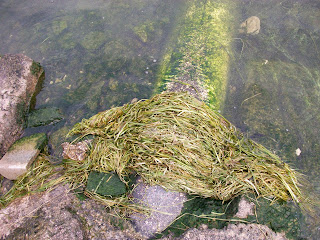
What I’m talking about is algae. It is seemingly everywhere in the waters of the western basin of Lake Erie. I have lived within eyesight of this most southern of the Great Lakes practically my whole life. I’ve been around long enough to remember similar lake conditions in the 1960s. It wasn’t pretty then; it’s not a pretty sight now.

Actually, I had almost forgotten about the mats of gelatinous material floating in our harbors and huge patches of the lake glowing pea green. At least to the extent I saw them late this summer.

For many years, following the ban on the use of phosphorus in detergents and the passage of the Clean Water Act, the actions taken to restore the Lake’s health (more accurately slow its decline) seemed to be having their intended effect. Most of the algae disappeared and the lake's water cleared. Many of us felt the lake was on the mend. But, when the algae erupted in such quantities again this summer, we became less sure. The lake's health appears to be regressing to conditions we hadn't seen in decades.

What does this have to do with the Green Industry? In my opinion, plenty.

The presence of algae in such quantities in Lake Erie involves three issues key to our industry — water quality, nutrient management and the role of turfgrass. The need for the first of the three is obvious. Questions surrounding the other two are gaining traction in the popular press and with lawmakers. That they’ll eventually become bigger here is an almost certainty as evidenced by rules in Minnesota and many regions of Michigan in recent years banning the use of phosphorus fertilizers on home lawns and commercial properties except where soil tests indicate a phosphorus deficiency or when establishing new turfgrass.

("County could ban urban phosphorus," Battle Creek Enquirer)

How much does modern lawn care practices contribute to the nutrient loading of streams, bays and lakes, in particular to my Lake Erie? Speaking for my small region of the Great Lakes, mostly rural northwest Ohio, my best guess is very little, at least compared to other sources of nutrients and pollutants.

To understand why the lake, especially the western basin, is so loaded with nutrients consider the geography of its watershed. A huge swath of low, fertile northwest Ohio and, to a lesser extent, northeast Indiana drains into the lake via the Maumee River, the largest river by volume emptying into the Great Lakes. Its brownish, silt-laden waters flow into Lake Erie at Toledo, Ohio. Several other usually slow-moving rivers that meander through farmland contribute to the load in this relatively shallow (average depth 30 ft.) part of the lake, as well.

Northwest Ohio, with the exception of Toledo, is mostly farmland, covered with thousands of acres of corn and soybean. Prior to settlement in the 19th Century, a goodly portion of this region of Ohio, called by early settlers The Great Black Swamp, was freshwater marshland. By the early 20th Century, farmers — many of them German immigrants — had drained the marshes, erected dikes and began turning and planting these rich, heavy soils.

Today less than 10% of the original marshlands, protected and managed by the feds and the state, remain

Nutrients also enter the lake via the Detroit River, which flows into the lake after passing between Detroit and Windsor, Canada. And, sometimes forgotten, at least by U.S. residents, are the thousands of acres of farmland abutting Lake Erie on the Canadian side of the lake.

Recognizing this, you have to wonder how much of the lake’s nutrient overload comes from turfgrass, in particular the practices used to keep it green and healthy. Do the practices we use to maintain turfgrass get more of the blame than they deserve when it comes to discussions about the health of our rivers, bays and lakes?

That varies somewhat from region to region and is dependent upon predominant land use patterns, but generally the practices that are used to grow and maintain healthy turfgrass do get more attention and blame than they deserve in discussions of water quality.
Yes, when we don’t follow best practices in our maintenance and fertility programs, we can and almost certainly do contribute to unsightly, costly and environmentally harmful effects to our water supplies. These best practices, of course, involve the intelligent use of turfgrass fertilizers. Obviously, we can't allow our chemical lawn care products, including fertilizers, to enter our waterways.

But looking at one specific example, my end of Lake Erie (the example I know most intimately), the contributions of healthy turfgrass to our environment, indeed to the health of Lake Erie, would seem to far outweigh any criticisms aimed at it as a contributor to the water quality and algae problem.

Wouldn't more and wider strips of turfgrass better protect our waterways from the runoff from our farms and along our roadways? Wouldn't larger areas of healthy turfgrass in our urban communities be preferable to pavement, asphalt and other impervious surfaces that allow runoff and all manner of pollutants into our streams, rivers and lakes?

While there have been more than a few research studies that have documented the role of turfgrass in slowing runoff and capturing pollutants, I'm wondering what scientific evidence there is that the procedures and products used in lawn care contribute to our nation's water woes. To date I haven't seen it. But if it's available, I would certainly share it on this blog. — Ron Hall

Wednesday, September 16, 2009

Tracking the M&A activity

You might think that with the economy being in the dumper the past 18 months or so that M&A deals in the landscape/lawn service industry would be kaput — wrong. Mergers and acquisition activity has been slow but far from dead.

Once the economy starts picking up steam, look for things to really get interesting. We're hearing that lots of 50-something owners in the landscape/lawn service arena are ready to cash out ..... for the right price, of course.

“Green Industry Merger & Acquisition News,” a nicely crafted email newsletter that arrives once every six weeks, tracks M&A's in the industry. We look forward to getting it because it provides a tidy recap of recently done deals. It is put out by an outfit known as The Principium Group, headquartered in Cordova, TN, which specializes in mergers and acquisitions in the landscape/lawn service industry. — LM Edit Staff

Tuesday, September 15, 2009

From the high seas to the lawn next door

Sea captain Bernardo Jorge Herzer, who logged more than 40,000 nautical miles on the high seas, hit a home run with the development of patented, hand-held landscape maintenance equipment powered with propane canisters.

His young company, Lehr Inc., is getting incredible press and earning accolades from environmental groups for his propane-powered blowers and trimmers.

Check out the 5-minute interview featuring Herzer on Fox media, by clicking here. Unfortunately, the interview is too short to find out what Herzer and his company plans to roll out next in the way of propane-powered landscape equipment. We’ll ask him at the upcoming GIE+EXPO 2009, Oct. 29-31, in Louisville, KY. — Ron Hall

Tuesday, September 08, 2009

Machine vs. man in evaluating turfgrass — machine more efficient


STILLWATER, OK—To measure turfgrass performance, professionals have traditionally relied on trained human evaluators who provide visual assessments of turf quality. But human evaluators require training and may be distracted by many factors that can affect accuracy and consistency of the assessments. New optical sensing technology has recently been introduced to measure the reflectance from turf canopies to determine turfgrass growth, wear tolerance, herbicide tolerance, and fertility.

A new study published in HortTechnology (to access the study, click here) assessed a handheld optical sensor (GreenSeeker) for evaluating overall turfgrass quality in three turf species over two growing seasons. The research team of Gregory E. Bell, Dennis L. Martin, Kyungjoon Koh, and Holly R. Han from Oklahoma State University compared the combined time required for visual evaluation and data entry with the time required for the same functions using the handheld optical sensor.

The study was conducted at the Oklahoma State University Turfgrass Research Center in Stillwater. Visual quality ratings and sensor ratings were collected on schedules prescribed by the National Turfgrass Evaluation Program for the 2002 bermudagrass (Cynodon spp.), 2002 buffalograss (Buchloe dactyloides), and 2002 zoysiagrass (Zoysia spp.) studies in 2003 and 2004.

The GreenSeeker handheld sensor used in the study incorporated a sensor head, a telescoping tube, a PDA, and a control box. A single sensor was mounted to a telescoping pole that comprised the primary structure of the handheld. A rechargeable battery rested on the opposite end of the pole to provide power and counterbalance the weight of the sensor. The entire unit weighed approximately 11 pounds and was suspended from an adjustable shoulder strap.

The researchers concluded that use of the sensor reduced the time required to complete data collection and data entry by 58% compared with human visual evaluation. "The GreenSeeker was relatively inexpensive and required less total combined time for data collection and entry than visual evaluation. The handheld sensor was very stable and did not require routine maintenance, update, and recalibration. It provided a consistent, objective evaluation of overall turfgrass quality", stated Bell.

Training personnel to use the handheld sensor, including data entry, took less than one hour; training a visual evaluator can require several days, and evaluators can take months to become proficient.

The researchers added that although the sensor has distinct advantages, there are still reasons to include the human element in turfgrass assessment. Bell noted that "the handheld optical sensor alone cannot provide necessary information about turfgrass texture or density that can be effectively determined by human evaluators. However, it does provide a consistent measure of reflectance that is primarily affected by a combination of turfgrass color and percent live cover."

Wednesday, September 02, 2009

St. Augustine grass gets the boot, what's next?

When it comes down to a battle between water use and turfgrass, turfgrass will lose, especially when cash-strapped cities start cutting maintenance budgets too.

That’s basically the deal in Orlando, FL, the self-proclaimed “City Beautiful,” where next month workers will begin removing about 1 million sq. ft. of St. Augustine turf from city right-of-ways, reported WFTV-9 recently. The city is replacing the St. Augustine with Bahiagrass, a common lawn grass in Florida, but one that’s almost universally considered to be inferior to St. Augustine.

A city official, in the WFTV news video, says the city will save more than $300,000 a year in water and maintenance costs by removing the St. Augustine. He says the city was using 52 million gallons of water annually to keep the St. Augustine healthy but it will count on Mother Nature to water the Bahia, allowing the city to recover the estimated $1 million cost of the conversion in about three years.

Veteran Orlando-area landscaper John Stires is quoted on the news video as describing the conversion as “a huge waste of money.”

Turfgrass is being scrutinized by the U.S. EPA in its WaterSense program (more about this in future blogs), and by decision-makers at almost every level of government, and sometimes without consulting with turfgrass experts or experienced plant people and landscapers.

We don’t know if this is the case with the Orlando decision, but there seems to be a lot of knee-jerk decisions being made to encourage property owners to remove or limit turfgrass on home lawns and commercial properties. In our opinion most of these decisions are being floated with too little thought to the consequences in terms of, not only aesthetics but urban cooling, dust abatement, erosion prevention, and the host of other environmental benefits turfgrass provides to our urban environments. — LM Edit Team

Tuesday, September 01, 2009

So you thought you knew water...

MENLO PARK, CA—Water is familiar to everyone—it shapes our bodies and our planet. But despite this abundance, the molecular structure of water has remained a mystery, with the substance exhibiting many strange properties that are still poorly understood. Recent work at the Department of Energy's SLAC National Accelerator Laboratory and several universities in Sweden and Japan, however, is shedding new light on water’s molecular idiosyncrasies, offering insight into its strange bulk properties.

In all, water exhibits 66 known anomalies, including a strangely varying density, large heat capacity and high surface tension. Contrary to other "normal" liquids, which become denser as they get colder, water reaches its maximum density at about 4 degrees Celsius. Above and below this temperature, water is less dense; this is why, for example, lakes freeze from the surface down. Water also has an unusually large capacity to store heat, which stabilizes the temperature of the oceans, and a high surface tension, which allows insects to walk on water, droplets to form and trees to transport water to great heights.

"Understanding these anomalies is very important because water is the ultimate basis for our existence: no water, no life," said SLAC scientist Anders Nilsson, who is leading the experimental efforts. "Our work helps explain these anomalies on the molecular level at temperatures which are relevant to life."

(Right: artist's depiction shows two distinct structures of water: in the foreground, tetrahedral low-density water and in the background, distorted high-density water. Image courtesy of Hirohito Ogasawara and Ningdong Huang, SLAC.)

How the molecules arrange themselves in water's solid form, ice, was long ago established: the molecules form a tight "tetrahedral" lattice, with each molecule binding to four others. Discovering the molecular arrangement in liquid water, however, is proving to be much more complex. For over 100 years, this structure has been the subject of intense debate. The current textbook model holds that, since ice is made up of tetrahedral structures, liquid water should be similar, but less structured since heat creates disorder and breaks bonds. As ice melts, the story goes, the tetrahedral structures loosen their grip, breaking apart as the temperature rises, but all still striving to remain as tetrahedral as possible, resulting in a smooth distribution around distorted, partially broken tetrahedral structures.

Recently, Nilsson and colleagues directed powerful X-rays generated by the Stanford Synchrotron Radiation Lightsource at SLAC and the SPring-8 synchrotron facility in Japan at samples of liquid water. These experiments suggested that the textbook model of water at ambient conditions was incorrect and that, unexpectedly, two distinct structures, either very disordered or very tetrahedral, exist no matter the temperature.

In a paper published in the Proceedings of the National Academy of Sciences, the researchers revealed the additional discovery that the two types of structure are spatially separated, with the tetrahedral structures existing in "clumps" made of up to about 100 molecules surrounded by disordered regions; the liquid is a fluctuating mix of the two structures at temperatures ranging from ambient to all the way up near the boiling point. As the temperature of water increases, fewer and fewer of these clumps exist; but they are always there to some degree, in clumps of a similar size. The researchers also discovered that the disordered regions themselves become more disordered as the temperature rises.

"One can visualize this as a crowded dance restaurant, with some people sitting at large tables, taking up quite a bit of room—like the tetrahedral component in water—and other people on the dance floor, standing close together and moving slower or faster depending on the mood or 'temperature' of the restaurant—like the molecules in the disordered regions can be excited by heat, the dancers can be excited and move faster with the music," Nilsson said. "There's an exchange when people sitting decide to get up to dance and other dancers sit down to rest. When the dance floor really gets busy, tables can also be moved out of the way to allow for more dancers, and when things cool back off, more tables can be brought in."

This more detailed understanding of the molecular structure and dynamics of liquid water at ambient temperatures mirrors theoretical work on "supercooled" water: an unusual state in which water has not turned into ice even though it is far below the freezing point. In this state, theorists postulate, the liquid is made up of a continuously fluctuating mix of tetrahedral and more disordered structures, with the ratio of the two depending on temperature—just as Nilsson and his colleagues have found to be the case with water at the ambient temperatures important for life.

"Previously, hardly anyone thought that such fluctuations leading to distinct local structures existed at ambient temperatures," Nilsson said. "But that's precisely what we found."

This new work explains, in part, the liquid's strange properties. Water's density maximum at 4 degrees Celsius can be explained by the fact that the tetrahedral structures are of lower density, which does not vary significantly with temperature, while the more disordered regions—which are of higher density—become more disordered and so less dense with increasing temperature. Likewise, as water heats, the percentage of molecules in the more disordered state increases, allowing this excitable structure to absorb significant amounts of heat, which leads to water's high heat capacity. Water's tendency to form strong hydrogen bonds explains the high surface tension that insects take advantage of when walking across water.

Connecting the molecular structure of water with its bulk properties in this way is tremendously important for fields ranging from medicine and biology to climate and energy research.

"If we don't understand this basic life material, how can we study the more complex life materials—like proteins—that are immersed in water?" asked Postdoctoral Researcher Congcong Huang, who conducted the X-ray scattering experiments. "We must understand the simple before we can understand the complex."

This research was conducted by scientists from SLAC, Stockholm University, Spring-8, University of Tokyo, Hiroshima University, and Linkoping University. The work was supported by the National Science Foundation, the Swedish Foundation for Strategic Research, the Swedish Research Council, the Swedish National Supercomputer Center and the Japanese Ministry of Education, Science, Sports and Culture through a Grant-in-Aid for Scientific Research.