It's time again for Rain Bird's Intelligent Use of Water Film competition. And that means you have another chance to win an all-expenses-paid trip for two to Southern California this October!
At the beautiful Paley Center in Beverly Hills, you'll join other Green Industry professionals and journalists in watching the films unfold on the big screen. The annual event helps recognize great filmmaking that raises awareness of the need to preserve the world's most fundamental resource. At the end of the screening, the audience will have an opportunity to name the year’s best film.
Enter the sweepstakes here.

Tuesday, July 31, 2012


Friday, July 13, 2012
Big clients CAN kill you
 By Jeffrey Scott, MBA
It almost happened to me: the biggest client we ever had (million ++), at a time when we really needed the money and cash (think: recession...15 years ago). He was a pain through negotiations, and yet we bit our tongues and signed him up with a big margin. Big mistake.
This client played all kinds of tricks on us, and he never intended to pay his final 10%. In fact, he brought troubles that I don't even want to recount in print. Sure, his cash helped us...initially....but his chaos hurt us. I have learned my lesson. The clients you say "No" to can be your best clients!
The other problem with big clients is they upset your sales cycle. You run out of time to develop new business because you are so busy with the "big" job. Trust me, this happens.
Are you feeling a cash crunch or a profit lull? Don't look for a silver bullet. Look for a better system and a better approach to your business. More of the same is just that....more sales on top of a bad financial or operational structure will do you more harm -- amplified.
When my consulting clients ask me to help them with sales, I don't automatically say, "Yes." I say, "Yes, tell me what's going on in the business." Sometimes sales will balance out your overhead, and sometimes it will make you lose more money.
Big clients are fun to brag about, but they can kill your morale and your wallet.
Jeffrey Scott, MBA, grew his landscape firm into a $10 million enterprise. He now helps owners transform and profitably grow their landscape businesses by coaching them within a peer group format. Learn about his peer groups at www.GetTheLeadersEdge.com or contact him at jeff@jeffreyscott.biz.
Jeffrey Scott, MBA, grew his landscape firm into a $10 million enterprise. He now helps owners transform and profitably grow their landscape businesses by coaching them within a peer group format. Learn about his peer groups at www.GetTheLeadersEdge.com or contact him at jeff@jeffreyscott.biz.
Tuesday, July 10, 2012
No one cares how much you know until they know how much you care
While flying to Chicago with 2 buddies for a golf getaway (one of them is from there) I am reading "The Big Miss" by Hank Haney. It's about his time coaching Tiger Woods. I keep referring back to a folded page featuring a quote from Kevin Kleven: "Nobody cares how much youu know until they know how much you care."
Randy's Take

Man, how appropriate is that saying? Take some time to reflect on that statement. It really sinks in. As an owner , a management person, foreman or supervisor are you a know-it-all and can't seem to get your point or points across? Does anyone seem to care? Do they tune out when you're talking? Does their body language twist and turn when you speak?Well, just maybe you have come across as a know-it-all and don't or haven't bonded with your team. Whether it is upper, middle or lower management, you have to have a connection with your team. And those in the hierarchy or chain of command must bond with their team and subordinates.You or they don't have to be best buds. Your team just needs to know you care about them. Caring means a lot. Whether it is listening to their needs or wants, take the time to listen to them. More importantly, ask about how their day went, how their weekend was, how their family's doing -- anything and everything about them. Do not make it about you! Let them talk. Remember what they talked about and what interested them. Then when you see them again, bring it up.Let them know you care. When they know you care, they will be interested in what you say and what you want to teach them. I guarantee they will work harder and smarter for you as well. Try it. If it doesn't work, email me and we'll work on another solution.Have an awesome day and week! Enjoy your summer and remember, we need to have fun along the way so we can be better bosses, managers and people.
Monday, July 09, 2012
Least we could do
It's hard not to get choked up when you're taking part in PLANET's Renewal & Remembrance event at Arlington National Cemetery. Here, for the past 16 years, Green Industry volunteers have convened to donate their time and materials to help preserve the hallowed grounds where so many of our country's finest men and women rest.
I caught myself tearing up during the Pledge of Allegiance, changing of the guard at the Tomb of the Unknown soldier and especially when a funeral procession rolled by and all the volunteers shut down their equipment as the caisson, troops and band passed. I'm kind of a crybaby, so it's no surprise, but I know I wasn't the only one welling up.
The 400 volunteers took a moment of silence during the opening ceremony this morning, and it seems as if another one's in order for those who couldn't make it.
But first, a recommendation: If you've never participated in this event, put it on your calendar for next year. I promise you won't regret it. Such service is a rite of passage, and the least we all could do. --Marisa Palmieri

I caught myself tearing up during the Pledge of Allegiance, changing of the guard at the Tomb of the Unknown soldier and especially when a funeral procession rolled by and all the volunteers shut down their equipment as the caisson, troops and band passed. I'm kind of a crybaby, so it's no surprise, but I know I wasn't the only one welling up.
The 400 volunteers took a moment of silence during the opening ceremony this morning, and it seems as if another one's in order for those who couldn't make it.
But first, a recommendation: If you've never participated in this event, put it on your calendar for next year. I promise you won't regret it. Such service is a rite of passage, and the least we all could do. --Marisa Palmieri
Thursday, July 05, 2012
Social media cheat sheet
Social media adoption among Green Industry businesses has vastly improved over the past few years, but it's likely many companies are participating in just one or two sites and haven't quite figured out the rest yet.
![]()
Infographic by Landscape Leadership
To help you decipher all of the different platforms and whether or not you should be using them, Chris Heiler, social media guru and founder/president of LandscapeLeadership.com, created this cool infographic. We especially like the "best for" box, which spells out the practical application of each tool. --Marisa Palmieri
Infographic by Landscape Leadership
Monday, July 02, 2012
Angry Birds?
Clean uniforms and tidy trucks are a point of distinction for many landscape and lawn care companies. Do you ever feel like you can't keep the bird droppings off of your vehicles, no matter how often your crews wash them?
Are your trucks red? A new study suggests they're birds' favorite targets.
A recent study conducted by British auto retailer Halfords analyzed 1,100 cars over two days, the Huffington Post reports. At the end of the period, 18 percent of the pooped-on cars were red, 14 percent were blue and 11 percent were black. White vehicles made up 7 percent, followed by gray/silver (3 percent) and green, which netted only 1 percent of the droppings.
Maybe it's time to think about switching to green trucks. --Marisa Palmieri
Are your trucks red? A new study suggests they're birds' favorite targets.
A recent study conducted by British auto retailer Halfords analyzed 1,100 cars over two days, the Huffington Post reports. At the end of the period, 18 percent of the pooped-on cars were red, 14 percent were blue and 11 percent were black. White vehicles made up 7 percent, followed by gray/silver (3 percent) and green, which netted only 1 percent of the droppings.
Maybe it's time to think about switching to green trucks. --Marisa Palmieri
Thursday, June 14, 2012
Getting More Done by Trading Services: A Fig Tree Story

By Jeffrey Scott, MBA
Some contractors tell me, "I just can't afford that right now." Usually they are putting off important decisions (marketing, website, training, consulting, etc.). They think they must first grow more profitable and then they can afford these critical services. This is backwards. Waiting often doesn't make things better! One possible solution is to trade services with other professionals. It is called bartering.
Many contractors have clients and colleagues who do marketing, online work, training and consulting. You just have to ask, and many of them would be glad to trade services with you.
I don't do this normally, but this week I helped out a young, very promising local garden designer and install maintenance company who just started a small garden center. The designer wanted to grow specialty plants and drive leads to her install business. She couldn't afford my whole fee, so we did some trading. And as a thank you gift, she gave me this lovely fig tree. My whole family is excited by the tree, how we need to take care of it, the fruit it will bear and how it will add a vertical dimension to our garden.
Your company won't bear fruit if you don't feed and water it. Don't stop growing! You have to invest in yourself in order to become prosperous.
Jeffrey Scott, MBA, grew his landscape firm into a $10 million enterprise. He now helps owners transform and profitably grow their landscape businesses by coaching them within a peer group format. Learn about his peer groups at www.GetTheLeadersEdge.com or contact him at jeff@jeffreyscott.biz.

Friday, June 08, 2012
Where did it all go?
 |
Randy's Take |
Where did all the money go? My intention for this blog is for the person who is starting a business or one in its infancy. Well, maybe it applies to those of us who have been in business many, many years and are trying to figure out where all our money is going.
After all your hard work, working well into the night, on weekends, seven days a week, and you look at your financial statements (you have them, right?) and then you see there's no where near the profits you think you should have. Where did it all go?
It could have gone many places. That is the importance of financial statements and more importantly a general ledger. The info on the general ledger comes from your chart of accounts. The chart of accounts is a listing of expenses from direct and indirect labor, materials, labor burdens, gas, auto and equipment repairs, phone, rents and a slew of other expenses you pay throughout the month and year.
A critical piece of the financial statements and general ledger is accurate cost accounting. Your expenses have to be coded to the correct expenses on the chart of accounts. With the monthly financial statements you need to review the general ledger. You can see every check that was written and to what expense it was coded.
Why is this important? There are many reasons, but two specific ones are, 1) You can see where all your money went, and 2) if everything was coded correctly to these chart of accounts, you can forecast and budget for the coming year and either increase, reduce or keep the same amount of money in your upcoming budget.
I am not a financial guru and have never taken any accounting classes. My explanations above may not be 100% on the money so to speak, but I have learned throughout the years by studying the financial statements, cash flow statements and really looking at the general ledger to see where we are spending our dough and if those expenses were coded correctly.
So if you are just starting out or fairly new to the business, I highly recommend you get with an accountant or bookkeeper and get your chart of accounts established and start coding your expenses so you can see where all your money is going.
If you would like to see our chart of accounts, please email me and in the subject line type chart of accounts. My email is rnewhard@newwaypro.com.
Remember — all of the flowers of all the tomorrows are in the seeds of today.
Tuesday, May 22, 2012
To be a good salesperson you need to become a great buyer
 |
| Jeffrey Scott |
Great Scott!
By Jeffrey Scott
If you are going to be efficient with your time and make a sale that is win-win, you should be working with potential customers who "need" what you have — not just "want" what you have. If they need you, it means they have a problem you can solve. If you are talking to a prospect who doesn't seem to have problems that you can uniquely solve, then you are not likely to be the winning salesperson. In fact, they may not even be looking to buy anything. The client has to prove to you that they have a problem. Pretend you are the buyer, not the seller, and look for the "value" that you can provide by uncovering the client's problem and making sure your solution is a good fit. Let them sell you on why you are a good fit for them.
Too often we look at a property and we think potential. This is a mistake.
A good salesperson is a detective. Whether you are selling residential or commercial, you need to identify three attributes to make a sale. The first attribute is identifying pain. Not just a problem, but the actual consequences of a problem. For example, the lawn is always burning out in the back (problem). And this is causing a deeper problem — the boss's office faces the back, and he keeps complaining about it to me — if I can't fix it, I am in trouble (pain!)
Let the prospect sell you on his or her problem, and find their deeper pain. Be a good buyer, and you will be a better salesperson.
If you want to learn the other two attributes to a successful sale, email me here.
Editor's Note:
Author, consultant and speaker Jeffrey Scott is joining the list of LM's regular blog contributors. Please look for his commentaries here periodically.
Scott is author of “The Referral Advantage” and “The Leader’s Edge,” both of which are available on LM's bookstore. He grew his landscape company into a $10 million enterprise, and now consults with others on how to do the same. He facilitates PEER GROUPS for landscape business owners who want to transform and grow their business. To learn more visit www.GetTheLeadersEdge.com.
Monday, May 21, 2012
So you think your Monday started rough
Editor's note: If you are easily queasy, please don't read this post.
Just got an email from a coworker:
"My buddy has his own landscaping company. He posted the following on Facebook. This could only happen to this guy."
"So you think your monday is bad ? I just had an 80 year old man tell me how his 12 yr old cocker spaniel is deaf and blind. Then i proceeded to accidentally run it over with a 52 inch scag riding mower ...
The old man then told me how i saved him $150.00 by not having to put him to sleep !
Terrible day"
Just got an email from a coworker:
"My buddy has his own landscaping company. He posted the following on Facebook. This could only happen to this guy."
"So you think your monday is bad ? I just had an 80 year old man tell me how his 12 yr old cocker spaniel is deaf and blind. Then i proceeded to accidentally run it over with a 52 inch scag riding mower ...
The old man then told me how i saved him $150.00 by not having to put him to sleep !
Terrible day"
Thursday, April 26, 2012
Free Joy Rides

 As part of the Cub Cadet Test Drive Challenge, the company brought a series of mowers to the plaza that sits between Progressive Field and Quicken Loans Arena — homes to the Cleveland Indians and Cleveland Cavaliers respectively. Between the two teams the company had an opportunity to reach nearly 30,000 fans in just one afternoon. The company, located in Valley City, not too far from downtown Cleveland, is a long-time supporter of the Cavaliers and was on hand as part of Fan Appreciation Night. The company even gave away one of its mowers as part of the Cavaliers' salute to fans.
The Cub Cadet Test Drive Challenge is a national tour with which the company is exhibiting its residential line of mowers to consumers around the country. The Cleveland stop is just about the mid-point of the tour.
 |
| LM Publisher Jason DeSarle demonstrates his zero-turning radius prowess. |
Cub Cadet set up a test course on the plaza to to show off a line of the company's zero-turning radius residential mowers. There was even a simulated grass area to help demonstrate the electronic power steering feature the mowers offer.
The Test Drive Challenge is about midway through its tour around the country, but any contractors that want to test one of the company's commercial mowers can visit any of the 1,500 or so dealers around the country — of course they might not walk away with the free key chain and T-shirt offered at the Test Drive.
Thursday, April 19, 2012
Always make time to play

It’s
a beautiful spring night after a good Alaskan storm soaked us with 1.3 in. of
rain here in Ramona, CA, resting in the foothills outside of San Diego, about
1,600 feet above sea level. About 45 minutes away, and another 3,000 feet more
in elevation, we had 3 in. of snow. Some buddies back east (outside Allentown,
PA) said we have had more rain and snow (in the nearby mountains) than they’ve
had this entire winter. Nice!
I
am sitting outside watching the Yankees lose to Minnesota Twins, but they
beat the Los Angeles Angels a couple nights ago. During one of the commercials,
I caught something about — always leaving time to play. And that prompted me
make a note to myself for my next blog.
Do
you make time to play? Play and work don’t sound like they mesh, but I am a
true believer. I practice both. Life is too short, and you never know when it’s
your time to leave this earth, so have fun along the way! And yeah, that means
at work too!
So,
how can you have fun at work? Well, work doesn’t always have to be serious. Yes,
you have a business to run or a job to do — that’s a given. We have to
give 110% all of the time. Times are tough, and if we do not give that 110% all
the time, the competition banging on your clients’ doors asking for your jobs
just might get them. Most clients aren’t just one job. Property managers
usually have a portfolio of work so chances are if you lose a job from a
property manager, you’ll need to work twice as hard to replace that revenue.
So,
back to that fun-at-work thing. Do you take the time and sit with your
employees and ask how was their weekend? How are the kids; baseball teams? Do you
take them to industry events like seminars, golf tournaments, association events
or other social functions? Do you have company picnics or go to ball games?
Take them golfing? Go out to lunch or even to a happy hour? What do you do to
get to know your employees better? For those of us with many employees, it is
very hard to get to know every single employee — but try and do this. We do!
If
you set the tone and take the time to know your top employees and at times,
have some fun with them, then they are more apt to work well with their teams,
and so on and so forth down the chain. We do a company picnic every year (on a Friday
and it’s a paid day). The account managers and branch managers cook for all New
Way’s teams — owners, execs, and all field personnel. That’s a lot of employees
to cook for! But our annual company picnic is a big deal for our employees. We
have a huge raffle where we get donations from our vendors. We also get gifts
from the points we accumulate from our business credit card. Last year our top
prize was a huge flat screen TV brought by our business attorney — and boy did
that make the winner happy!
At
this picnic I make sure I shake everyone’s hands and thank them for the hard
work they do — and I mean everybody!! At Christmas, we throw a party out
back of our corporate facility, and all the teams come in for camaraderie, food
and some words from me, New Way’s president Kathryn DeJong, and the VPs. Again,
I make sure to say “Merry Christmas,” “Feliz Navidad” and “thank you” to
everyone. If our employees don’t know how much we appreciate them, why
would they work harder to make us happy? They won't. It’s important to tell
your staff how without them, the business doesn’t run, because it doesn’t, and
all positions deserve our gratitude.
Now,
on the flip side, do you have fun with your clients? We sure do. Whether it is
taking people to Padres opening day, other Padres games, Charger games,
golfing, sponsoring them at industry events, happy hours, lunches, or just
a cup of coffee, we make it a point to have fun with our clients. Clients need
a break from work, and most of them like to get to know their vendors. It gives
you a chance to talk about something other than work to develop that all-important
relationship.
Do
you remember your clients’ and employees’ birthdays and anniversaries? Do you know
their spouses and their children? All these things help you connect with your
employees and clients, which can make having “fun” easier. Most of my friends
are our clients, and talking about work isn’t the way we got to be friends.
Despite the difficult and sometimes grueling task of running a business, I find
many different avenues to enjoy every bit of my work life — and that is through
the wonderful people that I have surrounded myself with throughout the past 32
years!
Tuesday, April 17, 2012
No good deed...
This is not the way to start a new life together.
Josh Miller, an Atlanta landscaper, was ready to pop the question to his girlfriend. He'd even bought the ring and hidden it in an old winter coat in the closet for a couple of months.
Unfortunately, he donated that coat to Goodwill. And proving that no good deed goes unpunished, when he realized his mistake and went the store to get the coat, it was already gone — along with the ring. Sadly the ring was uninsured, so the couple is currently at the mercy of the good will of whoever purchased the old coat.
Read the whole story here.
Josh Miller, an Atlanta landscaper, was ready to pop the question to his girlfriend. He'd even bought the ring and hidden it in an old winter coat in the closet for a couple of months.
Unfortunately, he donated that coat to Goodwill. And proving that no good deed goes unpunished, when he realized his mistake and went the store to get the coat, it was already gone — along with the ring. Sadly the ring was uninsured, so the couple is currently at the mercy of the good will of whoever purchased the old coat.
Read the whole story here.
Tuesday, March 13, 2012
Rising fuel prices don't have have to raise your blood pressure
 |
| Fred Haskett |
Fred's Take
As I was sitting in our
Friday Staff meeting the past few weeks I realized the discussions while
seemingly normal for the time of year – Spring Start-Up Operations – were all
happening several weeks earlier than normal. Due to the current reality of 2012
we are facing some different challenges this year, and some normal ones that
are more exacerbated than normal.
Nationwide we have had a
very mild winter St. Louis where I operate is no different.
The spring of 2012 promises
to present us with several challenges:
- Rising fuel costs
- Low cash flow due to lack of snow / or if you are not in a snow region lack of cash flow due to no real seasonal slow-down this winter.
- Horticultural challenges
What is the true impact of
rising fuel costs?
- Emotional – You are writing a much larger check for your fuel costs than you were a year ago.
- Practical – Fuel has risen 33%. And is still rising.
- The Geo Political and Domestic Political situation is such that our leaders appear poised to do what they do best - NOTHING!!
So how do we deal with it?
Let me share with you some of the things that we are brainstorming about.
We have talked about several
practical ways to address this situation.
- Verify all vehicles and equipment are properly tuned and maintained.
- Assign trucks with the best fuel mileage to the longest routes
- Check tire inflations daily
- Assign newer equipment that burns fuel more efficiently to large jobs
- Lighten the load on the truck by not carrying extra/unused equipment
- Use GPS tracking to monitor speeds, idling time, and unnecessary travel
- Work 10-hr days when practical
- When you have time ask your elected officials to do their job.
Another key is to speak with your customers about
changes to their program to help offset rising fuel costs that are outside of
your control. Do not act without talking to your customer.
Do NOT assess fuel charges
to your invoice.
Your
customer works with set budgets and raising your price may force them to take
bids. If you do opt to use fuel charges, do not add them to your invoice
without speaking to your customer first. Remember, their business is also
being impacted somehow by rising fuel costs.
Do NOT send out a form
letter announcing your intentions to adjust service levels or add fuel
surcharges.
Any
action should be discussed with your customer one on one.
Many of us either did not produce the anticipated snow
revenue this winter or in the year round markets you experienced a warmer than
normal winter and were not able to reduce service intervals as significantly as
you usually do. In either case, you possibly have not been able to save
enough cash to fund spring operations.
What are our options?
- Sell enhancements and request down payments to ease cash flow requirements
- Offer a discount for early payment to spur cash flow
- Discuss an adjustment to payment terms from your supplier
- Take advantage of trade credit and Early Order terms
- Begin and complete spring clean-ups and mulching operations early to reduce overtime when the season starts
- Investigate lines of credit BEFORE you need it
- Reduce overheads where possible
Horticultural Challenges
Spring
has definitely come early to most of the country. Agronomic applications
such as pre & post emergent weed control are driven by soil temperatures,
not by a calendar or air temperatures.
Do
you know the history of soil temperatures in your market?
Are
you monitoring soil temperatures in your area to stay on top of the situation?
Are
you checking in with your extension service to get their thoughts and advice of
the current reality.
Be sure you understand your customers’
expectations
· Are you on a performance based specification?
You
may have to start servicing early.
· Is the service period clearly defined?
Can
you start servicing early?
· If your customer is on set frequencies or
pre-determined season start dates, is there an opportunity for additional
income for extra services?
* Insect activity will also be high this year. In most
markets, cold weather reduces spring and summer insects. The same is true
for most weeds as well.
* In markets that did not receive normal snowfall –
drought conditions can also be expected.
So the best message I can
leave you with and what we are doing is:
* Be aware of the current reality!
* Make sure you are dealing with the current reality!!
* Communicate with your customers and be prepared for an
early start!!!
Kohler donates more than 10,000 engines to high schools and technical colleges nationwide
I must admit when I was in high school I had no interest in taking "shop" class. Oh, how foolish I was. The kids that took shop were "hoods" as we used to call them. Well now I pay those people I looked down my nose at a fair amount of money to fix my ever more complex car.
My attitude was wrong on so many levels, not the least of which, was that I though I was better than those kids. While I barely gave them a second thought many years ago, the people who can fix my car are extremely important in my life, now.
And it is with that new found appreciation that I applaud the donation Kohler has made to help ensure there will be plenty of well-trained technicians to fix the machines we rely on daily. Below is the press release from Kohler that details their gift. Bravo Kohler.
KOHLER, Wis. – In an effort to ignite a renewed
appreciation and understanding of small engines among high school and technical
college students nationwide, Kohler® Engines recently
donated more than 10,000 engines to hundreds of educational institutions across
the country. The company partnered with several non-profit organizations on the
one-time gift, that worked independently to distribute the engines to
interested schools. All of the donated engines have been delivered to numerous
schools from New York to California and almost every state in between.
“This has been a very rewarding process,” said Justin
Blount, director of marketing for Kohler Engines. “We’ve been touched by the level of response
this donation has received from students, facility and administrators at all of
the participating schools. We’ve received countless emails, letters and photos
from the people who directly benefited from this donation – and those have
certainly been appreciated by everyone here at Kohler.”
The organizations that helped distribute the donated
engines on Kohler’s behalf, include: SkillsUSA, a non-profit partnership of
students, teachers and companies working together to ensure America has a
skilled workforce; the Equipment and Engine Training Counsel (EETC), a
non-profit association whose goal is to address the shortage of qualified service
technicians in the outdoor power equipment industry; Fox Valley Technical
College Foundation, in Appleton, Wis.; and Hinds Community College Foundation
in Jackson, Miss. Each of these organizations distributed the engines only to
schools who agreed to utilize the donated product exclusively for educational
purposes. Individual classrooms within the participating schools were eligible
to receive up to 24 engines each.
The products donated by Kohler were Courage® XT 7 hp
vertical-shaft engines, which are typically utilized in equipment such as
walk-behind lawn mowers and pressure washers. Students with access to the
donated engines are now able to gain critical hands-on experience, while also
enhancing their knowledge of a variety of engine-related topics, including
assembly and disassembly, components, torque values, engineering processes, the
general functioning of internal combustion engines, and more.
“As a leading engine manufacturer, we’re very interested
in working with future generations of technicians and consumers to make sure
they understand the craftsmanship and attention to detail that goes into each
engine bearing the Kohler name,” Blount continued. “This recent donation
presented an ideal opportunity to connect directly with students across the
country while also aiding the administrators and faculty who play such a
critical role in shaping the leaders of tomorrow with needed equipment.”
To learn more,
visit www.KohlerEngines.com or www.facebook.com/kohlerengines.
About Kohler Co.
Founded in 1873 and headquartered in Kohler, Wis., Kohler Co. is one of America’s oldest and
largest privately held companies. KOHLER is a global leader in the manufacture
of kitchen and bath products, engines and power generation systems, cabinetry,
tile and home interiors, and an international host to award-winning hospitality
and world-class golf destinations.
Wednesday, March 07, 2012
Machines of Glory

Go to just about any equipment show and you'll find an equipment rodeo that pits operator against operator in a skills competition. Many operators are incredibly talented and need a venue to showcase their skills.

The new program, hosted by ABC's "Extreme Makeover: Home Edition's," Johnny Littlefield, the show takes three teams of three and puts them through their paces competing against one another in a series of "outrageous challenges that put their skills to the test in three areas of ability — speed, skill and power — while operating massive machines including powerful excavators, speedy backhoes, agile skid steers, massive wheel loaders and nimble dozers." And those machines were donated by the good folks at Caterpillar.
Below are a few images from the first few episodes.


Monday, February 13, 2012
Improve, change or fade away?

Improve, change or fade away?
“God, Randy what kind of title to an article is this,” I said to myself. Well, it’s an inevitable piece of advice we must do in life, whether its in our business life or personal life. My little dictionary says the word “change” means: to make or become different, to replace with another. And for “improve” it says: to enhance or increase in value or quality, to grow and become better. I wont look up “fade away” because we aren’t going there.... but companies can and do fade away if needed change or improvement doesn’t happen.
Let’s talk about change even though we know most people don’t like change. Why not? Well, it is uncomfortable and we all get comfortable in our own little world. Comfort is nice and secure. It feels good. Change means we have to do something different. Yep, that is in the definition — become different (or those words contractors dread) — to replace with another. Ouch!
How do we change our mindset as an owner or employee to be different when we are comfortable with what we’ve been doing? You might say, “I have worked hard for so many years to get where I am, and I don’t need to change. I have climbed the ladder and I am happy where I am.”
Let’s get to reality quickly. Our clients and their mindset have changed. We must become different in how we strategize and plan our future. Our sole function as vendor, affiliate, partner — whatever you want to call us — is to create value for our clients. What can we do to be different? How do we make ourselves stand out to our clients; how can we improve our relationships?
It all begins with communication. How often are you talking to your clients? Only when there is a problem? Only when they call you? If so, that’s not good. I can guarantee you right now, for most of your clients (especially the large dollar clients) there are two or three other landscapers who have talked to them in the last month. They want their foot in the door and they are communicating with “your” clients. Again I ask, “Are you communicating with them, too?”
So this may be your change part. But this is not that difficult — pick up the phone and call them this coming week. Thank them for their business. Tell them you appreciate them. Ask them how you can improve your service. Hmmm, there's that improve word from the title above. What else can you do for them? How about educate them. Everyone wants to become more knowledgeable, and clients appreciate you taking the time to teach them more about landscaping. I just met with a client the other day, and he told me that an employee of ours and him go way back (not our employee at the time) and the customer credits our employee with teaching him 50% of what he knows about landscape. See how much of an impression this employee made on this client that he brought this up from over 30 years ago!
There’s the value part of the word improve. This employee created value for his company back then and guess what — our company has value now with this client! This client referred us to one of his clients and we have picked up about $50,000 worth of tree work in the last month! Can you say, “nice?”
Take the time to talk to your clients. I know as a business owner you might have the time to talk to all your clients. But does your staff make or take the time to do the same? They need to be trained and they need to be given the tools and techniques in how to communicate. Times have changed, and the means by which we can communicate has changed. There is no reason we can’t communicate now. Communication brings trust! Truth and communication is the subject of another blog. As mentioned in one of my past blogs I am out for now, its time to hit the links!
Friday, January 27, 2012
Plant in need
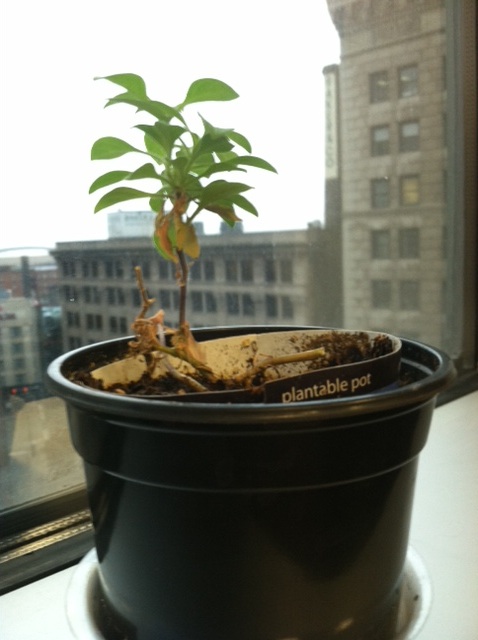
I try to avoid looking at it. Because every time I see it I am racked by guilt. Every day when I arrive to work, there it is -- looking forlorn and woefully neglected: My plant.
It started as a vibrant, hot pink petunia. Now, it's not much of anything. Just look at it. I haven't seen the semblance of a flower in months. And just last week I cut nearly all of its stems and leaves off. It seemed only right. They all had evolved to brown crisps. "Help me!" the plant seemed to be saying. I suppose I could have watered it a little more. OK, a lot more.
My tragic neglect of the plant has given it a staunch following. People around here check up on it daily. They leave shaking their heads. Because despite my desperate attempt to resuscitate it, the plant never shows marked improvement. In fact, I'm not convinced it's still a flowering plant. But those in the know assure me it's definitely not a weed.
I will continue to work hard to bring it back to life. All I can do is keep watering it, I guess. Unless you have better advice? I welcome your feedback. Help me help my plant.
Monday, January 23, 2012
Do our trainers know how to train?
Another entry from Fred Haskett, Managing Partner – Operations, U.S. Lawns of West
and St. Charles County
Do we
really know how to “Train Our Trainers?
A lot of us are in the midst of
working on our “Training Programs.” This is an area that, as I
have talked to different people around the industry is a continuing source of
angst. We live in an information rich environment. There are literally hundreds
of places to get technical and business information. At PLANET (the Professional
Landcare Network) members are lucky to have at their fingertips: programs,
books, videos, DVD’s, CD’s etc. These represent some of the most cutting edge
information and data available.
Yet with all of this
“STUFF” why is training still a constant source of frustration for us large or
small?
IN REALITY… (though, we
like to think otherwise) … OUR PEOPLE NEVER RISE TO
THE OCCASION … THEY ALWAYS DEFAULT TO
THEIR LEVEL OF TRAINING!!!
I do not think the problem is in
finding the RIGHT STUFF. The problem is: Do we, as owners and
managers, know how to TEACH the RIGHT WAY. To be effective, we as
trainers need to be familiar with the nature of the Teaching-Learning Process
Teaching is
directing the learning process – Motivating – Reinforcing – Satisfying Needs –
Creating Interest – all toward the trainees goals.
Learning is
the process by which a trainee, through his own activity, becomes changed in
behavior.
Training Methods are
those techniques (procedures / processes) used by the trainer to instruct the
trainees in the knowledge, skills, and competencies necessary to achieve the
objectives of the lesson.
BEFORE YOU TRY TO TEACH …
you should know how people learn.
There are five basic ways in
which trainees learn. Your job as a teacher / trainer is to select the way or
combination of ways best suited not only to your trainees, but also to the
particular thing being taught.
PEOPLE LEARN BY:
1)
Doing: Performing a new job in the same way, with the same tools
and equipment, under the same conditions as they will have to do this task in
an actual real-life situation.
2)
Thinking: Solving a real-life difficulty or problem: getting the
facts needed to solve it; discussing it with others; arriving at decisions;
putting the decisions into action, and testing them.
3) Seeing: Observing a thing being
done; studying pictures, charts, videos, illustrations, and real objects
4) Being
Told: Getting information and instruction through words – written,
spoken, or printed.
5)
Being Checked and Corrected: Learning through mistakes brought to
their attention in a positive manner by an alert, competent trainer.
I have found over the years that adults learn their basic and fundamental
skills and tasks best with a combination of these processes. At our company we
have been using the following training process for the past few years and have
seen a definite up-tick in the effectiveness and results from our training
efforts and events.
The most important thing about this process is that:
… You must utilize it
consistently and in the sequence it is presented in.
…
You cannot skip steps and achieve the results you want.
I have found also that providing this simple tool to your
trainers will make them more comfortable and less fearful of their role as a
trainer.
We call it -- SHOW, DO, WATCH, COACH
EFFECTIVE TRAINING PROCESSES AND PROCEDURES
1) WHAT: Explain what it is that
you are going to train on.
2) WHY: Explain why you do what
you are going to train on.
3) LISTEN: Have the trainee explain what
and why we do the specific process or procedure.
4) SHOW: Demonstrate to the trainee the
specific process or procedure.
5) DO: Have the trainee demonstrate the
specific process or procedure.
6) WATCH: Observe the trainee demonstrating
the specific process or procedure.
7) COACH: Explain to the trainee what they did
right and what they need to correct.
8) SHOW:
Repeat the demonstration of the specific process or procedure emphasizing
the areas the trainee needs to correct.
9) DO: Have the trainee
re-demonstrate the specific process or procedure with the corrections you demonstrated.
10) WATCH: Observe the trainee
re-demonstrating the specific process or procedure.
11) COACH:
Explain to the trainee what they did right and what they need to correct.
Repeat steps 8, 9, 10, and as required.
FINALLY … AND MOST IMPORTANTLY
12) PRAISE: Compliment the trainee on their
successful accomplishment.
A Simple Process … that can and will apply
to virtually any person or any area of your business.
As we all know … Training is not a full time job it
is an all the time job.
If your trainers have the right tools they can get the
job done for your trainees.
Subscribe to:
Posts (Atom)