Tuesday, March 13, 2012

Rising fuel prices don't have have to raise your blood pressure

Fred Haskett

Fred's Take

As I was sitting in our Friday Staff meeting the past few weeks I realized the discussions while seemingly normal for the time of year – Spring Start-Up Operations – were all happening several weeks earlier than normal. Due to the current reality of 2012 we are facing some different challenges this year, and some normal ones that are more exacerbated than normal.

Nationwide we have had a very mild winter St. Louis where I operate is no different.

The spring of 2012 promises to present us with several challenges:

  • Rising fuel costs
  • Low cash flow due to lack of snow / or if you are not in a snow region lack of cash flow due to no real seasonal slow-down this winter.
  • Horticultural challenges

What is the true impact of rising fuel costs?
  • Emotional – You are writing a much larger check for your fuel costs than you were a year ago.
  • Practical – Fuel has risen 33%. And is still rising.
  • The Geo Political and Domestic Political situation is such that our leaders appear poised to do what they do best  - NOTHING!!

So how do we deal with it? Let me share with you some of the things that we are brainstorming about.

We have talked about several practical ways to address this situation.
  • Verify all vehicles and equipment are properly tuned and maintained.
  • Assign trucks with the best fuel mileage to the longest routes
  • Check tire inflations daily
  • Assign newer equipment that burns fuel more efficiently to large jobs
  • Lighten the load on the truck by not carrying extra/unused equipment
  • Use GPS tracking to monitor speeds, idling time, and unnecessary travel
  • Work 10-hr days when practical
  • When you have time ask your elected officials to do their job.

Another key is to speak with your customers about changes to their program to help offset rising fuel costs that are outside of your control. Do not act without talking to your customer.

Do NOT assess fuel charges to your invoice. 
Your customer works with set budgets and raising your price may force them to take bids.  If you do opt to use fuel charges, do not add them to your invoice without speaking to your customer first.  Remember, their business is also being impacted somehow by rising fuel costs.

Do NOT send out a form letter announcing your intentions to adjust service levels or add fuel surcharges.
Any action should be discussed with your customer one on one.

Many of us either did not produce the anticipated snow revenue this winter or in the year round markets you experienced a warmer than normal winter and were not able to reduce service intervals as significantly as you usually do.  In either case, you possibly have not been able to save enough cash to fund spring operations.

What are our options?
  • Sell enhancements and request down payments to ease cash flow requirements
  • Offer a discount for early payment to spur cash flow
  • Discuss an adjustment to payment terms from your supplier
  • Take advantage of trade credit and Early Order terms
  • Begin and complete spring clean-ups and mulching operations early to reduce overtime when the season starts
  • Investigate lines of credit BEFORE you need it
  • Reduce overheads where possible

Horticultural Challenges
Spring has definitely come early to most of the country.  Agronomic applications such as pre & post emergent weed control are driven by soil temperatures, not by a calendar or air temperatures.

Do you know the history of soil temperatures in your market?
Are you monitoring soil temperatures in your area to stay on top of the situation?
Are you checking in with your extension service to get their thoughts and advice of the current reality.

Be sure you understand your customers’ expectations
·       Are you on a performance based specification?
You may have to start servicing early.
·       Is the service period clearly defined?
Can you start servicing early?
·       If your customer is on set frequencies or pre-determined season start dates, is there an opportunity for additional income for extra services?

*  Insect activity will also be high this year. In most markets, cold weather reduces spring and summer insects.  The same is true for most weeds as well.

*  In markets that did not receive normal snowfall – drought conditions can also be expected.


So the best message I can leave you with and what we are doing is:

* Be aware of the current reality!

* Make sure you are dealing with the current reality!!

* Communicate with your customers and be prepared for an early start!!!


Kohler donates more than 10,000 engines to high schools and technical colleges nationwide

   I must admit when I was in high school I had no interest in taking "shop" class. Oh, how foolish I was. The kids that took shop were "hoods" as we used to call them. Well now I pay those people I looked down my nose at a fair amount of money to fix my ever more complex car. 
   My attitude was wrong on so many levels, not the least of which, was that I though I was better than those kids. While I barely gave them a second thought many years ago, the people who can fix my car are extremely important in my life, now.  
   And it is with that new found appreciation that I applaud the donation Kohler has made to help ensure there will be plenty of well-trained technicians to fix the machines we rely on daily. Below is the press release from Kohler that details their gift. Bravo Kohler.


KOHLER, Wis. – In an effort to ignite a renewed appreciation and understanding of small engines among high school and technical college students nationwide, Kohler® Engines recently donated more than 10,000 engines to hundreds of educational institutions across the country. The company partnered with several non-profit organizations on the one-time gift, that worked independently to distribute the engines to interested schools. All of the donated engines have been delivered to numerous schools from New York to California and almost every state in between.

“This has been a very rewarding process,” said Justin Blount, director of marketing for Kohler Engines.  “We’ve been touched by the level of response this donation has received from students, facility and administrators at all of the participating schools. We’ve received countless emails, letters and photos from the people who directly benefited from this donation – and those have certainly been appreciated by everyone here at Kohler.”

The organizations that helped distribute the donated engines on Kohler’s behalf, include: SkillsUSA, a non-profit partnership of students, teachers and companies working together to ensure America has a skilled workforce; the Equipment and Engine Training Counsel (EETC), a non-profit association whose goal is to address the shortage of qualified service technicians in the outdoor power equipment industry; Fox Valley Technical College Foundation, in Appleton, Wis.; and Hinds Community College Foundation in Jackson, Miss. Each of these organizations distributed the engines only to schools who agreed to utilize the donated product exclusively for educational purposes. Individual classrooms within the participating schools were eligible to receive up to 24 engines each.

The products donated by Kohler were Courage® XT 7 hp vertical-shaft engines, which are typically utilized in equipment such as walk-behind lawn mowers and pressure washers. Students with access to the donated engines are now able to gain critical hands-on experience, while also enhancing their knowledge of a variety of engine-related topics, including assembly and disassembly, components, torque values, engineering processes, the general functioning of internal combustion engines, and more.

“As a leading engine manufacturer, we’re very interested in working with future generations of technicians and consumers to make sure they understand the craftsmanship and attention to detail that goes into each engine bearing the Kohler name,” Blount continued. “This recent donation presented an ideal opportunity to connect directly with students across the country while also aiding the administrators and faculty who play such a critical role in shaping the leaders of tomorrow with needed equipment.”

About Kohler Co.
Founded in 1873 and headquartered in Kohler, Wis., Kohler Co. is one of America’s oldest and largest privately held companies. KOHLER is a global leader in the manufacture of kitchen and bath products, engines and power generation systems, cabinetry, tile and home interiors, and an international host to award-winning hospitality and world-class golf destinations.

Wednesday, March 07, 2012

Machines of Glory

       Put a pair of contractors in a couple of machines and your going to have two things — a business (or at least potential for one) and more importantly (at least from the perspective of the employees) a competition.
       Go to just about any equipment show and you'll find an equipment rodeo that pits operator against operator in a skills competition. Many operators are incredibly talented and need a venue to showcase their skills.

      So, it's not surprising (especially with the proliferation of reality shows) that television gurus have found a way to turn these competitions into entertaining television. "Machines of Glory," which features equipment provided by Caterpillar, is expected to air toward the end of the month (check your local listings) on the Discovery Channel.

     The new program, hosted by ABC's "Extreme Makeover: Home Edition's," Johnny Littlefield, the show takes three teams of three and puts them through their paces competing against one another in a series of "outrageous challenges that put their skills to the test in three areas of ability — speed, skill and power — while operating massive machines including powerful excavators, speedy backhoes, agile skid steers, massive wheel loaders and nimble dozers." And those machines were donated by the good folks at Caterpillar.

Below are a few images from the first few episodes.


Monday, February 13, 2012

Improve, change or fade away?

Randy's Take — Randy Newhard, owner New Way Landscape and Tree Service

Improve, change or fade away?


“God, Randy what kind of title to an article is this,” I said to myself. Well, it’s an inevitable piece of advice we must do in life, whether its in our business life or personal life. My little dictionary says the word “change” means: to make or become different, to replace with another. And for “improve” it says: to enhance or increase in value or quality, to grow and become better. I wont look up “fade away” because we aren’t going there.... but companies can and do fade away if needed change or improvement doesn’t happen.

Let’s talk about change even though we know most people don’t like change. Why not? Well, it is uncomfortable and we all get comfortable in our own little world. Comfort is nice and secure. It feels good. Change means we have to do something different. Yep, that is in the definition — become different (or those words contractors dread) — to replace with another. Ouch!

How do we change our mindset as an owner or employee to be different when we are comfortable with what we’ve been doing? You might say, “I have worked hard for so many years to get where I am, and I don’t need to change. I have climbed the ladder and I am happy where I am.”

Let’s get to reality quickly. Our clients and their mindset have changed. We must become different in how we strategize and plan our future. Our sole function as vendor, affiliate, partner — whatever you want to call us — is to create value for our clients. What can we do to be different? How do we make ourselves stand out to our clients; how can we improve our relationships?

It all begins with communication. How often are you talking to your clients? Only when there is a problem? Only when they call you? If so, that’s not good. I can guarantee you right now, for most of your clients (especially the large dollar clients) there are two or three other landscapers who have talked to them in the last month. They want their foot in the door and they are communicating with “your” clients. Again I ask, “Are you communicating with them, too?”

So this may be your change part. But this is not that difficult — pick up the phone and call them this coming week. Thank them for their business. Tell them you appreciate them. Ask them how you can improve your service. Hmmm, there's that improve word from the title above. What else can you do for them? How about educate them. Everyone wants to become more knowledgeable, and clients appreciate you taking the time to teach them more about landscaping. I just met with a client the other day, and he told me that an employee of ours and him go way back (not our employee at the time) and the customer credits our employee with teaching him 50% of what he knows about landscape. See how much of an impression this employee made on this client that he brought this up from over 30 years ago!

There’s the value part of the word improve. This employee created value for his company back then and guess what — our company has value now with this client! This client referred us to one of his clients and we have picked up about $50,000 worth of tree work in the last month! Can you say, “nice?”

Take the time to talk to your clients. I know as a business owner you might have the time to talk to all your clients. But does your staff make or take the time to do the same? They need to be trained and they need to be given the tools and techniques in how to communicate. Times have changed, and the means by which we can communicate has changed. There is no reason we can’t communicate now. Communication brings trust! Truth and communication is the subject of another blog. As mentioned in one of my past blogs I am out for now, its time to hit the links!

Friday, January 27, 2012

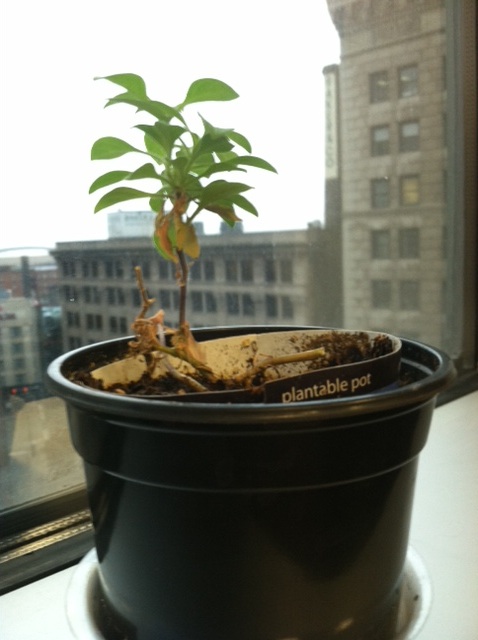
Plant in need


I try to avoid looking at it. Because every time I see it I am racked by guilt. Every day when I arrive to work, there it is -- looking forlorn and woefully neglected: My plant.

It started as a vibrant, hot pink petunia. Now, it's not much of anything. Just look at it. I haven't seen  the semblance of a flower in months. And just last week I cut nearly all of its stems and leaves off.  It seemed only right. They all had evolved to brown crisps. "Help me!" the plant seemed to be saying. I suppose I could have watered it a little more. OK, a lot more.

My tragic neglect of the plant has given it a staunch following. People around here check up on it daily. They leave shaking their heads. Because despite my desperate attempt to resuscitate it, the plant never shows marked improvement. In fact, I'm not convinced it's still a flowering plant. But those in the know assure me it's definitely not a weed.

I will continue to work hard to bring it back to life. All I can do is keep watering it, I guess. Unless you have better advice? I welcome your feedback. Help me help my plant.


Monday, January 23, 2012

Do our trainers know how to train?

Another entry from Fred Haskett, Managing Partner – Operations, U.S. Lawns of West and St. Charles County

Do we really know how to “Train Our Trainers?
A lot of us are in the midst of working on our “Training Programs.” This is an area that, as I have talked to different people around the industry is a continuing source of angst. We live in an information rich environment. There are literally hundreds of places to get technical and business information. At PLANET (the Professional Landcare Network) members are lucky to have at their fingertips: programs, books, videos, DVD’s, CD’s etc. These represent some of the most cutting edge information and data available.
Yet with all of this “STUFF” why is training still a constant source of frustration for us large or small?
IN REALITY… (though, we like to think otherwise) … OUR PEOPLE NEVER RISE TO THE OCCASION … THEY ALWAYS DEFAULT TO THEIR LEVEL OF TRAINING!!!
I do not think the problem is in finding the RIGHT STUFF. The problem is: Do we, as owners and managers, know how to TEACH the RIGHT WAY. To be effective, we as trainers need to be familiar with the nature of the Teaching-Learning Process
Teaching is directing the learning process – Motivating – Reinforcing – Satisfying Needs – Creating Interest – all toward the trainees goals.
Learning is the process by which a trainee, through his own activity, becomes changed in behavior.
Training Methods are those techniques (procedures / processes) used by the trainer to instruct the trainees in the knowledge, skills, and competencies necessary to achieve the objectives of the lesson.
BEFORE YOU TRY TO TEACH … you should know how people learn.
There are five basic ways in which trainees learn. Your job as a teacher / trainer is to select the way or combination of ways best suited not only to your trainees, but also to the particular thing being taught.
PEOPLE LEARN BY: 
1)     Doing: Performing a new job in the same way, with the same tools and equipment, under the same conditions as they will have to do this task in an actual real-life situation.
2)     Thinking: Solving a real-life difficulty or problem: getting the facts needed to solve it; discussing it with others; arriving at decisions; putting the decisions into action, and testing them.
3)   Seeing: Observing a thing being done; studying pictures, charts, videos, illustrations, and real objects
4)    Being Told: Getting information and instruction through words – written, spoken, or printed.
5)     Being Checked and Corrected: Learning through mistakes brought to their attention in a positive manner by an alert, competent trainer.
I have found over the years that adults learn their basic and fundamental skills and tasks best with a combination of these processes. At our company we have been using the following training process for the past few years and have seen a definite up-tick in the effectiveness and results from our training efforts and events.
The most important thing about this process is that:
                   … You must utilize it consistently and in the sequence it is presented in.
               … You cannot skip steps and achieve the results you want.
I have found also that providing this simple tool to your trainers will make them more comfortable and less fearful of their role as a trainer.
We call it  --  SHOW, DO, WATCH, COACH
EFFECTIVE TRAINING PROCESSES AND PROCEDURES
1) WHAT: Explain what it is that you are going to train on.
2) WHY: Explain why you do what you are going to train on.
3) LISTEN: Have the trainee explain what and why we do the specific process or procedure.
4) SHOW: Demonstrate to the trainee the specific process or procedure.
5) DO: Have the trainee demonstrate the specific process or procedure.
6) WATCH: Observe the trainee demonstrating the specific process or procedure.
7) COACH: Explain to the trainee what they did right and what they need to correct.
8) SHOW: Repeat the demonstration of the specific process or procedure emphasizing the areas the           trainee needs to correct.
9)  DO: Have the trainee re-demonstrate the specific process or procedure with the corrections you           demonstrated.
10) WATCH: Observe the trainee re-demonstrating the specific process or procedure.   
11) COACH: Explain to the trainee what they did right and what they need to correct. Repeat steps 8, 9, 10, and as required.
FINALLY … AND MOST IMPORTANTLY
12) PRAISE: Compliment the trainee on their successful accomplishment.
A Simple Process … that can and will apply to virtually any person or any area of your business.
As we all know … Training is not a full time job it is an all the time job.
If your trainers have the right tools they can get the job done for your trainees.

Thursday, January 19, 2012

The People Have Spoken

The people have spoken, and they had good news for the California Landscape Contractors Association (CLCA). That's because at the Wild and Scenic Film Festival, held Jan. 15 in Nevada City, CA, the CLCA's documentary, "Rock the Boat," garnered the People's Choice Award. Congrats, CLCA!

The film, which the CLCA sponsored and co-produced, chronicles a group's 51-mile boating expedition down the cement-lined Los Angeles River in 2008. Over the Army Corps of Engineers' objections, the group of 12 coasted down the river on a quest. Their mission: to have the EPA declare the Los Angeles River navigable so it could be eligible for protection under the Clean Water Act. And it ultimately did gain protection under the act, on July 7, 2010.

"We think this movie brings attention to what the river is now and what it could be in the future," said Chuck Carr, the CLCA's director of communications. "With California's water issues, rather than see all the water pushed out to sea, there are lots of ways to harness some of that water for Los Angeles to use."

For more information about the documentary or to see a trailer, visit http://www.rocktheboatfilm.com/.

Friday, January 13, 2012

ASABE to develop new water use standard

The American Society of Agricultural and Biological Engineers wants to establish a new standardized process, and it needs your help.

The Society is launching a project that will develop a standardized procedure for determining water available for irrigation use. Those with expertise in irrigation and water issues are encouraged to participate.

Establishing a standardized process would enable landscapers to better address local, regional and national water-related initiatives, the Society stated in a release. It added that the new document will standardize the ways available water resources and irrigation requirements are quantified.

For more information or to participate, contact Travis Tsunemori at travist@asabe.org or 269.932.7009.

Friday, December 23, 2011

The H-2B seasonal guest worker program creates and protects jobs for professional and skilled American workers


*Editor's Note: Fred Haskett, Managing Partner – Operations, U S Lawns of West and St. Charles County, offers his thoughts on recent challenges to the H-2B seasonal worker program. Look for more commentary from Fred periodically on the Landscape Management Blog.


A few days ago we said goodbye to our H-2B team. This is always bittersweet – we are glad they are going home to be with their families, their sacrifice of not seeing their wives and children for eight to nine months at a time is something we are greatly aware of and admire them for.

However, most of them have been an integral part of our team / our family for the past 8 years, and we always miss them when they are gone. This year especially, when we have no idea – Thanks to our interference from our Government – if we will ever see them again.

As has been our custom the past few years, we had a dinner the night before they left. Our leadership team shared a few hours with them and talked about family, children, the Holidays and all manner of personnel issues that friends and co-workers share when they come together outside of the workplace.

The next morning Jason Winans our Operations Manager, Mike Harpole our Production Superintendent, and myself drove some of them to the airport and others to the bus station. We all shook hands, grabbed a hug, and told them to travel safe. There were excited smiles and a few tears as they went on their way home to their native land.

During the past seven years St. Louis has become their home away from home and the source of income that makes it possible for them to send their children to high school and university. To have luxuries that we take for granted: Indoor plumbing, telephones, windows, and basic appliances. To have a career that they can be proud of.

During the past seven years these individuals have given us a stable and predictable seasonal workforce and allowed us to grow our small business by 400% in that time period and to provide good, well-paying, seasonal jobs for them and good, well-paying year-round jobs with benefits to our professional / skilled U.S. workers.

My company is a family-owned landscape and lawn care company with a 41-person team. By way of comparison, in 2004, we had only nine team members, six of whom were seasonal.
                 
Since the 2005 season, we have participated in the H-2B visa program to hire seasonal foreign workers to meet the company’s need for a reliable and stable seasonal workforce. Currently, of the 41-person staff, the management team is my-self, my wife, and six year-round landscape professionals.  There are also five other full-time, year-round salaried employees.  The seasonal workforce consists of 28 workers, of whom 25 are H-2B seasonal workers.

Without the H-2B program, none of this would have been possible.  Before we began using the H-2B program in 2005, our annualized turnover rate was well over 200%.  Our effort to recruit U.S. workers to fill seasonal jobs and remain in them through the entire season was largely unsuccessful.  Today, with the H-2B program, turnover is less than 10%. 

If turnover increased to the level we experienced before turning to the H-2B program, our company would suffer serious economic and non-economic injury.

  • It would divert resources away from customer service to hiring, training and replacing.
  • It would reduce the quality of our service and result in the loss of customers and good will.
  • It would reduce our operational efficiency and negatively affect our profitability 
  • Our worker safety would all suffer as large numbers of inexperienced or barely experienced people would be present on each crew.
  • Turnover at the 200% rate that we experienced before using the H-2B program would require that we hire and train two or three new workers every single week during a 36-week season; recruiting and hiring over 100 people just to maintain 28 positions. 
  • Since workers often leave without notice, we would be constantly short-handed. 

This would result in an enormous negative impact on company morale and client satisfaction. 

If these new rules proposed by the Department of Labor for the H-2B program go into effect it will leave companies like ours few choices in the short term. The only choices it seems to me are to close our doors or to shrink our company by 40% to 50% and try to deliver a viable service level with turnover rates of up to 200%.  Even under this second scenario up to 50% of our full time skilled workforce would lose their jobs, and worker safety and quality of service would suffer.

It will take, I estimate, two to three seasons of very hard focus develop the new training systems required and to go through enough seasonal workers to find a small group of reliable people who are willing to work in a seasonal environment.

If these new H-2B Rules are allowed to take effect, at BEST,” we will lose irreplaceable skilled professional employees and valued customers, and, at worst, we will lose a family business that we have worked to build and will put all of our U.S. employees out of work.


 — Fredric R. Haskett   
Landscape Industry Certified Manager
Managing Partner – Operations
 U S Lawns of West and St. Charles County

Thursday, December 22, 2011

Ohio State Research Shows Dollar Value of Urban Trees

Thanks to the research of a graduate student in the Department of Entomology at The Ohio State University and funding from Bayer Environmental Science, the city of Wooster, OH now knows the true value of the trees that line its streets.

By "value" we don't simply mean trees' contribution to the ecosystem or the fact that they beautify landscapes. Rather, we mean trees' true dollar value.

In mid-2010, the graduate student, Alejandro Chiriboga, recorded tree attributes such as trunk circumference and leaf condition among more than 3,000 of Wooster's city-owned trees. Using Forest Service software, he then totaled the dollar value of the environmental services trees provide, including reducing pollution and carbon in the atmosphere.

Chiriboga's research concluded that, annually, the trees generate $270,153 in community services, including aesthetic benefits, energy conservation, stormwater control and carbon and air pollution reduction. Chiriboga's study found that most of Wooster's street trees are young and healthy, which means they will contribute environmentally--and therefore economically--to the city well into the future.

Things in nature have always seemed priceless. So this study raises an interesting question: Can you really put a dollar amount on them? Apparently, you can. The question now is, will this experiment stop at trees? Or will it extend to lawns, shrubs and plants on the landscape?

Will mowing a lawn be deemed a loss in dollars? Will planting a flower bed boost the value of a landscape? It's hard to say. But at the very least, the OSU study has given us something new and interesting to ponder.

Thursday, December 15, 2011

Owners — Are you in or out?


Randy's Take

Randy Newhard
Are you in or out? 

It’s a tough question to ask and honestly answer. I am both — in and out. I would think your answer depends on how long you have been in business. For me, it almost depends on the day, week or month — but mostly the week. I have been running my own business for 32 years. Sometimes I want out. Ok honestly, I want out most of the time. I have worked the 80-100 hour weeks for decades. Guess I am not smart enough, thinking I should have been done a while ago. Or am I?

Having this child (the business) and having over 200 grandkids (employees) and all their siblings — probably over a 1,000 — it’s very hard to let go. It sure is like parenting, you constantly have to teach, train, say no and also pat them on the back.  Grandkids (your employees ) need to know they are loved and cared for. That's where you have to be in. This caring for your child (company) really comes from the top.

You can hire the best management team in the world and they can be the best managers, but bottom line is: Employees want to know you care about them. Yes, money is in the top three things employees care about, but number one is that they want to be involved in the growth of the business and want to know what is going on. 

Secondly, they want to know their boss cares about them. Their bosses need to be trained in order to offer care and counseling. Be firm with consequences if they don't do their job. Sometimes, we’re not so good at this. It is a family business and family atmosphere, sometimes that can get in the way. But we are working on it.

While writing this blog entry, Newhard is definitely "out." Here's his photo
of a sunset while enjoying a meal with his family while vacationing in Maui.

I know I will probably never be out completely, as my exit strategy is my daughter, and working side by side with her has been a wonderful experience. Heck, she's taught this old man a lot of new tricks. She has been with our company for 15 years. Yep, right out of high school. Starting with answering the phones, to marketing, office manager, developing our databases and internal structures and processes, to corporate director-steering the ship, and now as president of the company, how can I be out completely? We make a great team!

I have the ultimate luxury, from wanting to be out — being out golfing with friends and clients, entertaining clients and taking off an extra day of the week to be with wife and my biological grandkids — Gabe and Olivia. And then being in — being at work, interacting with the other grandkids (employees), saying thanks and keeping an eye on the financials.

So are you in or out? Can you afford to be out? By afford I mean, how can you walk away from your child and the grandkids after 32 years?  I’m in... Well maybe not for now, I am out. I am in Maui celebrating my wife’s birthday, with my daughter, fiancé and our real grandkids. Aloha!

Randy Newhard, CEO
New Way Landscape & Tree Services
2nd Generation Local Family Owned Business
Multi Local & State Landscape Beautification Award Winner

Monday, December 12, 2011

Cleaning up after the Occupy Toronto protest

   We got the following email from our friend Tom Delaney, Director of Government Affairs for the Professional Landcare Network (PLANET):

   "The Occupy Toronto movement trashed one of Toronto's inner city Parks. When the City issued a plea for financial support to help restore the park, one of our members came up with the idea that we as an industry should just restore the park ourselves. One email and two days of hard but very satisfying work later, 150 volunteers aerated the entire park, spread 1 inch of topsoil and sodded all 3 acres. It was an amazing experience. Everything was donated."

The park following the day of volunteer work.
Here's what the park looked like following
the Occupy Toronto protesters vacated the site.
  

   Apparently about $60,000 in product and services was donated by members of Landscape Ontario.  It's yet another example of the extraordinary people we have in our industry. 

   There are a couple of videos about the work at St. James Park. In one, someone put a stop-motion camera in place and with the addition of a background track ("Flight of the Bumblebees" if I'm not mistaken) created this highly entertaining YouTube video

   The good deed also got coverage from a Toronto television station. See that here.

Tuesday, December 06, 2011

Don't lose sight of how to win, close, motivate and rally in 2012

Randy Newhard

Editor's Note: Randy Newhard, CEO of New Way Landscape & Tree Services will begin contributing to Landscape Management's blog on a regular basis. Here is his first submission.

Randy's Take

As I write my first blog, I am watching my struggling Chargers on Monday Night Football vs. the Jaguars. The Bolts have lost six straight. Their main goal this year was to start strong. Is your company’s goal to start the new year strong? Most companies do start the year strong, set goals, monitor them for a few months and then lose sight of them.

Companies can be just like our Chargers who started 4-1 and then lost sight of how to win, how to close, how to motivate and how to rally a team.

Yeah, I do have to give the Chargers some slack. The quarterback Philip Rivers lost a lot of his receivers to injuries early. They could not practice together during the week as the players healed. His linemen also got hurt, some out for year, some out for many games.

Does your quarterback, your owner, your general manager or your operational person have healthy personnel on your team? Are they hurt or injured- feeling down from down economy? Are they motivated? Do they practice together — have quality meetings in the office and in the field?

How about your sales team — do they have goals for the month, quarter and year? Do they have the tools they need? Are they motivated and by whom? Are they motivated by salary, incentives, commissions?

There are lots of things to do this time of the year. Whether you are back East or on the West coast or in the Midwest, the new year brings many challenges. There is a lot of planning to do for the new year and a great deal of equipment to get cleanup and ready for spring.

As a business owner, it's time for us to cleanup 2011 and plan for 2012. It's time to budget and set realistic expectations for our team to be empowered to make proper decisions to make our companies profitable. Yep, profitable. Some clients don't think we should make one. That's a topic for future blogs.

Have a wonderful holiday season and yes I will say it — Merry Christmas and wishing you and yours a very  prosperous and Happy New Year!

— Randy Newhard, New Way Landscape & Tree Services, is CEO of this 2nd generation local family owned business. The San Diego-based company is a multi local and state Landscape Beautification Award Winner.

Friday, December 02, 2011

You can't buy this kind of coverage

If it's true — what goes around, comes around, then Glen Rock, NJ-based R&S Landscaping is in for some good karma this holiday season (and maybe it's already happening in the coverage they got from the New Jersey Media Group).

It seems R&S Landscaping decided to help celebrate one of the company's long-time customer's 70th birthday by giving her a holiday lighting package. "The Hoefler family is one of our first customers so we're excited to be able to offer them the gift of this complimentary service," said Robert Schucker, president, R&S Landscaping in the Glen Rock Gatzette, part of the New Jersey Media Group. Read the full story here.

You simply can't buy that kind of good will coverage. And the grateful recipient is quoted in the article saying she makes sure every one of her neighbors knows who is responsible for the beautiful display. What is it they say about word-of-mouth referrals?

We don't know if R&S has received any direct new business from the publicity, and we're not suggesting you go out and provide free services every year, but when the right opportunity comes along, it might be worth the investment.

Thursday, December 01, 2011

Just when you thought it was safe to head back to the grocery store

There's a local talk show host here in Northeast Ohio who likes to use the phrase "I'm living in a world I don't understand." I'm beginning to agree with him.

A few weeks back we heard about the incident of a family that was busted by a Safeway security guard when they forgot to pay for a sandwich their famished daughter ate while they were shopping. Read the details of that incident here. Well, Safeway is at it again.

This time, at store in Northwest Washington, a girl was threatened with arrest and forced to sign a paper acknowledging she is no longer welcome in Safeway stores for eating some apricots and then putting the bag back on the shelf. That might seem a reasonable solution if not for the fact that the hardened criminal in this case only 4 years old and hadn't yet learned to read or write.

The company has apologized and relieved the security guard of his duties,  and the store's divisional president offered to take the girl around the story (including a visit to the bakery) to show her the grocery store is not a scary place. While the hire ups were quick to react and ultimately did the right thing (read about the story here) it shows that common sense isn't as common as we might like.

I'm not sure how you teach common sense or instill it in your employees, but if those on the front lines of your business don't have it, you could be in trouble. These incidents certainly aren't going to close the food chain's doors, but it's not really doing them any favors. I can only imagine if my kids were still that young, I'd hesitate to walk through those doors. And that can't be the kind of feeling any business wants to provide its customers.